
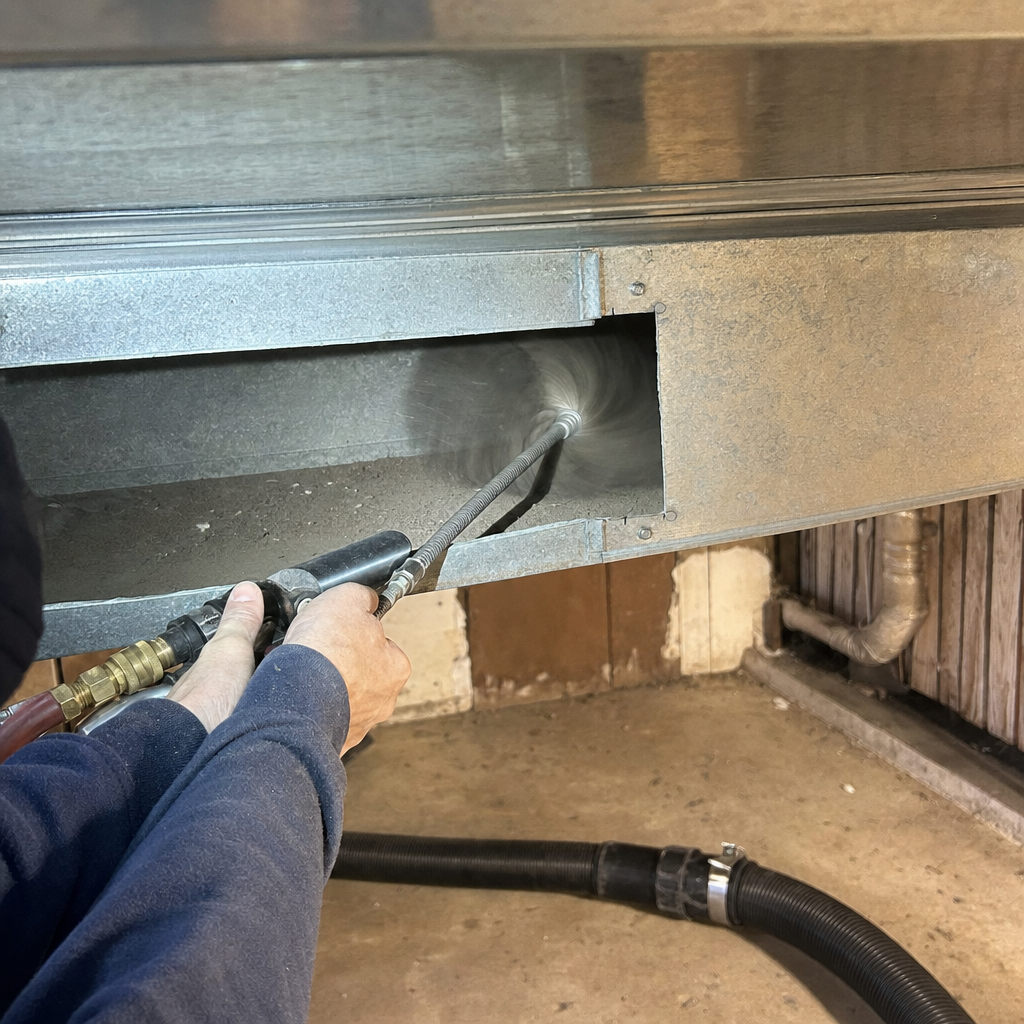
Rotobrush Vent Sanitizing: The Philadelphia Owner’s Guide
Rotobrush vent sanitizing in Philadelphia typically runs $280-$450 installed, and we stock the compatible fogger assemblies and replacement nozzles for same-day service on most calls. Most homeowners realize their Rotobrush sanitizing system needs attention when they notice the mist output dropping or smell returning within days of a cleaning. We take a look at what is actually there, and then we tell you what we found.
Which Rotobrush Models This Applies To
The vent sanitizing setup on Rotobrush systems is not universal across their product line. If you’re running a Rotobrush Beast series, the fogger mount and solution line routing differ from the older Classic II and BrushBeast units. The Beast uses a quick-connect manifold that sits higher on the hose assembly, while Classic II models need the older threaded collar that Rotobrush phased out around 2017. Check the silver spec plate on your main vacuum housing, not the brush head, for the series designation. The sanitizing module itself carries a separate part label near the solution tank, usually marked with an “S” prefix.
We carry both OEM Rotobrush sanitizing modules and the Abatement Technologies equivalent that threads onto the same collar. The Abatement unit runs about forty dollars less and carries the same two-year warranty. For the Beast series specifically, we’ve seen aftermarket adapters that claim cross-compatibility but don’t seat fully, which strips the threads in the manifold. That’s a four-hundred-dollar mistake we fix a few times a year in houses along the Main Line.
Signs Your Rotobrush Vent Sanitizing Is Failing
- Weak or intermittent mist output. The ceramic disc inside the fogger head scales up with Philadelphia’s hard water, especially in neighborhoods fed by older municipal mains in Germantown and Mount Airy. Once the disc surface pits, it can’t atomize the solution consistently no matter how much you adjust the flow valve.
- Chemical smell during operation but no visible mist. The solution is passing through the line and pooling in the duct without atomizing. This usually means the ultrasonic generator has failed while the pump still runs, which wastes sanitizer and leaves ducts wet.
- Solution backflow into the vacuum hose. The check valve between the sanitizer line and the main vacuum has cracked or stuck open. On Rotobrush units, this valve sits at a low point where condensation collects, and we’ve found it fails faster in Philadelphia’s summer humidity than in drier climates.
- Complete silence when the sanitize switch engages. The 24-volt transformer that powers the fogger module has burned out. This happens more often on older Classic II units where the transformer shares a circuit with the main motor starter, creating a voltage drop on startup.
- Visible corrosion on the solution tank fittings. The original Rotobrush tanks used a zinc-coated fitting that reacts with quaternary ammonium sanitizers over time. We replace these with nickel-plated equivalents that hold up to the chemistry.
Replacement Cost & What’s Included
| Service | Price Range | What’s Included |
|---|---|---|
| Fogger module replacement (OEM Rotobrush) | $320-$400 | Module, new solution line, check valve, 90-day labor warranty |
| Fogger module replacement (Abatement equivalent) | $280-$350 | Module, new solution line, check valve, 90-day labor warranty |
| Ultrasonic disc replacement only | $180-$240 | Disc, gasket set, calibration, 90-day labor warranty |
| Full sanitizing system rebuild | $420-$520 | Module, tank, lines, fittings, camera verification, 90-day labor warranty |
What moves you toward the higher end: if we need to fish new lines through a finished basement ceiling in a Fishtown rowhouse, or if the manifold threads are damaged and need helicoil repair. What’s included in every job: camera inspection before and after, so you see the mist pattern actually reaching the full duct run. No surprises on the bill. The price we quote on the phone is the price on the invoice.
DIY or Call Us?
There’s no high-voltage or spring-tension danger in a Rotobrush sanitizing module, but there is a practical one: misdiagnosing the failure point. We’ve had Philadelphia homeowners replace the fogger head twice when the real problem was a cracked solution line hidden behind the vacuum canister, or a failing check valve that let moisture back into the motor housing. The module itself is simple to swap, but tracing why it failed takes knowing what order these systems fail in after fifteen years of local water chemistry.
What you can safely check: whether the solution tank is seating fully, whether the filter screen at the tank outlet is clogged with crystallized residue, and whether the power indicator on the module lights when the switch engages. Beyond that, the camera inspection tells the real story. Call (833) 962-5679 and we’ll walk through what you’re seeing before you spend money on parts you might not need.
FAQs
In Philadelphia’s hard water and humidity, expect five to seven years on the original ceramic disc, or eight to ten if you’re running softened water. The ultrasonic generator typically outlasts the disc by a few years. Call (833) 962-5679 for an exact quote on replacement, estimates are free.
The ceramic disc can be replaced independently, which saves about a hundred dollars if the generator and housing are sound. Cracked housings or corroded electrical contacts mean full replacement. We check both paths during our inspection and tell you which makes sense. Call (833) 962-5679 for an exact quote, estimates are free.
Most Rotobrush sanitizing replacements take forty-five minutes to an hour, including the camera verification. If we’re pulling new lines through a finished space, add another thirty minutes. We complete most jobs in a single visit. Call (833) 962-5679 to schedule, estimates are free.
We carry both OEM Rotobrush and Abatement Technologies modules on every truck, plus the common failure items: ceramic discs, check valves, solution lines, and tank fittings. Same-day service is standard in Philadelphia and the surrounding counties. Call (833) 962-5679 to confirm availability for your model.
Written by Dennis Farrell, Owner, Bellows Air Duct & Vent Co. of Philadelphia at Bellows Air Duct & Vent Co. of Philadelphia, serving Philadelphia and nearby areas.